
Jackson County Projected Release Meaning
A projected release date is a sentence calculation based on the facts currently recorded. It is forward-looking. Earned-time awards or losses, corrected confinement credit, a changed judgment, a new sentence, or another agency's hold can alter it. An actual release date is retrospective. It records that a custody event occurred. Even then, the person may have transferred, entered post-release supervision, or remained held by another sovereign.
At Jackson County Detention Center, pretrial custody turns on judicial action and satisfaction of release conditions. There is no sound date calculator for an unresolved case. For a sentenced county term, the jail applies the judgment, credit for time already confined, and lawful earned-time rules. State prison sentences are calculated by NCDAC and can show a projected date in Offender Public Information, or OPI.
| Custody status | Date source | What the date proves |
|---|---|---|
| Pretrial in county jail | Court orders and jail status | No fixed release date exists before conditions or a later order resolve custody |
| Sentenced in county jail | Judgment, confinement credit, jail calculation | An expected local sentence end, subject to lawful changes |
| North Carolina state prisoner | NCDAC OPI and sentence record | A projected prison release or an actual past release, as labeled |
| Released under supervision | NCDAC supervision component | Prison custody ended, but the correctional sentence may continue |
Find Jackson County Projected Release
Begin with last known custody. The NCDAC offender search is appropriate for a state prisoner or a person under state community supervision. It is not a Jackson County jail database. NCDAC says its public data covers state imprisonment and probation, parole, or community supervision, with historical material back to 1972, but excludes county- and city-jail records.
Search by offender number when possible. If only a name is known, use the name and birth fields, then compare conviction county, offense, admission date, and sentence details. Open all relevant record components. A headline “inactive” label in one component does not prove the person has no active supervision or another case.
- Classify the last custody as Jackson County jail, NCDAC state prison, federal custody, immigration detention, or another jail.
- For NCDAC, search by offender number or name and review the Most Recent Incarceration Summary and sentence history.
- Write down the exact label beside each date. Projected Release Date and Actual Release Date answer different questions.
- For county custody, call Jackson County Detention at 828-586-2458 and obtain the judgment or commitment record through the clerk.
- Ask the proper custodian for the existing calculation or release record when a web label is missing, stale, or unclear.
The broad county search and records-request sequence appears on the Jackson County released inmates page. It is the better path when a person merely vanished from the county roster and no state sentence has been established.
Note: A failed NCDAC search cannot disprove a Jackson County jail booking, release, dismissal, or bond event.
Jackson County NCDAC Date Fields
An NCDAC detail record may show a photograph, offender number, inmate status, and a separate Probation/Parole/Post Release status. Its incarceration summary can include total term, conviction date, admission date, control status, movement, locations, and Projected Release Date. Sentence history may add the county, docket, offense, minimum and maximum terms, commitment type, Actual Release Date, projected date, parole dates, and service status.
The fields vary by record and era. Do not promise that every result contains each field. Record the label exactly. “Maximum release date” may not be the expected prison departure when a statutory post-release period is part of the maximum. An actual release date confirms a past prison movement, but an active supervision component means the person has not yet reached full discharge.
The NCDAC public inactive-result example captured in the manifest demonstrates how actual and projected fields can appear together.
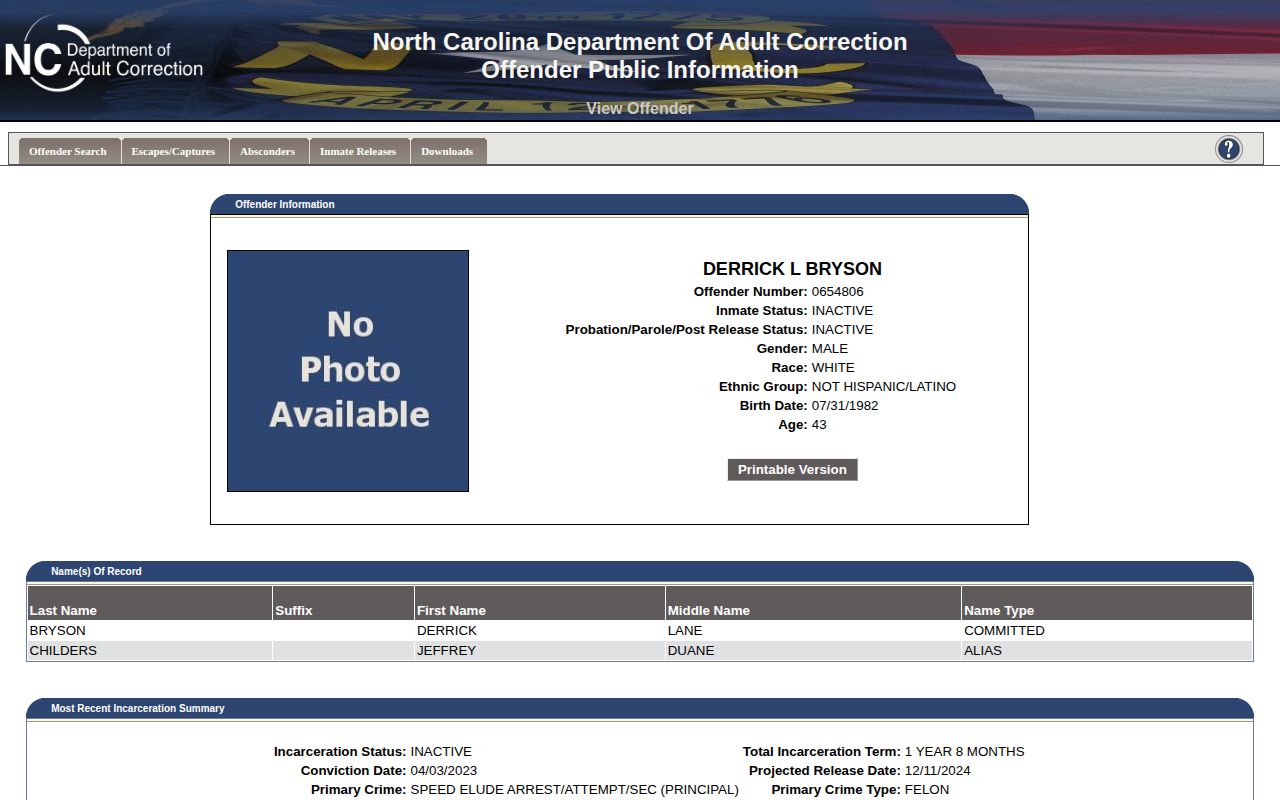
The image is an interface example, not a current projection for the person shown. It demonstrates why the field label and current status must travel with any date.
Jackson County Actual Release Check
NCDAC also maintains a dedicated Inmate Releases search. It searches state-prison releases by county, year, and month. Jackson appears as county code 50. Results can show a linked offender number, name, release date, primary offense and qualifier, and release type. Verified release types include EXPIRATION and PAROLE/RETURN TO PAR. This is a released-first state tool, not a forecast of who will leave next.
The county choice in that form is an NCDAC search dimension. It does not turn the results into a Jackson County Detention Center daily log. A person who bonded out of the county jail without a state commitment may never appear. Likewise, a state-prison release associated with Jackson County does not establish that the person was released from the county jail on that date. Use the offender number to open the full record and compare its actual date with the projected field that appeared before release.
This distinction provides a strong way to audit an old projection. If the actual date differs, inspect sentence history, movement, and supervision components before assigning a reason. The public interface may not expose every calculation change. For a formal answer, request the existing NCDAC record and identify the offender number, incarceration period, projected field, actual release date, release type, and supervision status sought.
Jackson County and NCDAC are different custodians. County public-record staff cannot certify a state sentence calculation, while NCDAC cannot turn its release search into a county booking record. The court clerk holds the judgment that connects the sentence to the case. Matching those three sources prevents a state actual date from being presented as a local jail departure.
North Carolina Release Calculations
North Carolina Structured Sentencing does not support a blanket claim that each incarcerated person serves 85 percent. Under G.S. 15A-1340.13, a court imposes minimum and maximum felony terms from the proper sentencing framework. Subsection (d) allows earned-time credit against the maximum, but not enough to reduce it below the minimum. The minimum term is therefore the key floor for an ordinary structured-sentencing felony, subject to the exact statute and judgment.
G.S. 15A-1368.2 in Article 84A governs the move into post-release supervision. For covered felony classes B1 through E, the statutory post-release component is generally 12 months. For classes F through I, it is generally nine months. Certain offenses calculated under G.S. 15A-1340.17(f) use a 60-month component. The prison release point is the maximum imposed term less the applicable supervision period and earned time. That transition is release from imprisonment into supervision, not full discharge.
Misdemeanor sentences follow G.S. 15A-1340.20(d), which permits earned time under NCDAC rules. G.S. 148-13 authorizes earned- and good-time regulations. Subsection (e) directs distribution of applicable rules to local jail administrators for sentenced jail prisoners. Earned time differs from credit for pretrial confinement, which may appear in the judgment and commitment record.
Note: Use the sentence-specific statutes and recorded judgment; a generic percentage calculator can produce a false Jackson County release date.
What Changes Jackson County Release
A projected release date changes when the underlying inputs change. Some shifts arise from behavior and earned time. Others come from courts, sentence administration, or a different custodian. The public date may lag while a new judgment or credit correction is processed.
| Factor | Possible effect | Best confirmation |
|---|---|---|
| Earned-time award or forfeiture | Moves the calculated date within statutory limits | NCDAC or jail sentence calculation |
| Disciplinary action | May remove credit under applicable rules | Custodian's calculation record |
| Confinement-credit correction | Changes time credited before or during the sentence | Judgment, clerk file, and custodian |
| New or amended court order | Can alter sentence terms or release conditions | Official court file |
| Concurrent or consecutive sentence change | Reorders or extends the aggregate term | Sentence history and judgments |
| Detainer or transfer | May end one custody while another continues | Releasing and receiving agencies |
| Parole or supervision action | Can change prison release or return a person to custody | NCDAC and Commission records |
A detainer is a notice that another agency seeks custody. Departure from Jackson County Detention Center under a detainer should not be called return to the community. Likewise, a state prison release can lead directly to post-release supervision. The correct record states where one custody ended and what status followed.
Jackson County Jail Date Rules
No Jackson County-specific public policy was found for weekend acceleration, set release-hour batches, or a local earned-time rate. That absence is important. Do not import a weekend-release rule from another state or apply an online 85-percent estimate. For a pretrial detainee, the court release order and satisfaction of its terms control. For a sentenced jail inmate, the judgment, credit for confinement, lawful earned time, and the jail's calculation control.
Ask the Jackson County Detention Center for the existing calculation or use the county public-record channel for the release record. Ask the Jackson County Clerk of Superior Court through the official contact directory for the judgment and later orders. These offices are separate. The jail can document custody processing, while the clerk holds the court record that authorized the sentence or change.
If the local departure was a transfer to NCDAC, wait for state intake and search OPI. A county release timestamp proves only that Jackson County custody ended. The receiving state status determines whether the person remains confined and when a later state release is projected.
Confirm Jackson County Release Dates
VINELink and North Carolina's NC SAVAN service can provide a custody-change alert while a matched record is active. Registration is helpful when a projected date remains in the future, but an alert reflects data sent by the participating agency. It is not a certified release document. The Jackson County VINELink inmate search explains the county-jail and state-prison notification routes.
For a state prisoner, pair the alert with the current NCDAC detail and an actual release date. For a county detainee, call Detention and obtain the county release record or court order. For a federal prisoner, use the Bureau of Prisons locator, not NCDAC. Immigration detention uses ICE channels. One system cannot establish the end of every other custody.
When a date matters, save the offender or booking number, exact field label, responsible agency, and date accessed. Then request the existing record from that custodian. This preserves the difference between an estimate, a completed release, a transfer, and full discharge.
Note: Confirm an expected date again near release because court, credit, discipline, transfer, and supervision data can change.